
Quantum machine learning (QML) aims to use quantum-in-the-knowledge resources to improve learning performances. How current out-of-the-box algorithms compare with carefully optimized classical algorithms is unclear at present. We compare QML paradigms all quantum models run on a noise-free state vector simulator (Qiskit Aer) against three classical baselines: a kernel SVM, Random Forest and XGBoost. The three QML models are (i) the Variational Quantum Classifier (VQC), (ii) a quantum-optimized support vector machine (QSVM) and (iii) a hybrid quantum-classical Multi-Layer Perceptron (HQ-MLP). Quantum models are trained on subsets of the binary MNIST dataset (digits 0 vs. 1, PCA-reduced to between 4 and 8 features) and tested on the remaining data. In addition, we use four synthetic, two-class benchmark problems: circles, moons, a multi-cluster data set, and spirals. Accuracy, the area under the ROC curve (AUC), training time and prediction time are reported for each. On the MNIST dataset, the quantum and hybrid models reach 97.50–98.33% accuracy, within one percentage point of the classical models (99.33%). On the synthetic data sets, quantum and hybrid models perform similarly (94.00–96.25%) to classical SVM and XGBoost (92.50%) but less well than Random Forest (100%). The HQ-MLP attains the highest accuracy among the quantum models at near-classical cost, with VQC and QSVM requiring approximately one to two orders of magnitude longer to train and more than an order of magnitude longer to infer at in. Simulation. We explain why these outcomes should not be taken as evidence for quantum advantage, examine threats to validity and enumerate the experiments needed to demonstrate it.
Turn pages by dragging a corner, clicking a page, or with the ← → keys.
Loading article…
Open the PDF instead
DOI: https://doi.org/10.63328/IJRDES-V8RI5P3
OpenYou've reached the end of this article.
Jampana Usha Rani , Kondapalli Venkata Ramana , " Comparative Analysis of Quantum Machine Learning Algorithms: Variational Quantum Classifiers, Quantum Support Vector Machines, and Hybrid Quantum-Classical Networks " , International Journal of Research and Development in Engineering Sciences (IJRDES), Volume 8, Issue 5 , pp 18 - 29 , October 2026. CrossRef DOI: https://doi.org/10.63328/ijrdes-v8ri5p3

Renewable energy sources, particularly solar energy, are essential to meeting the world's growing en...
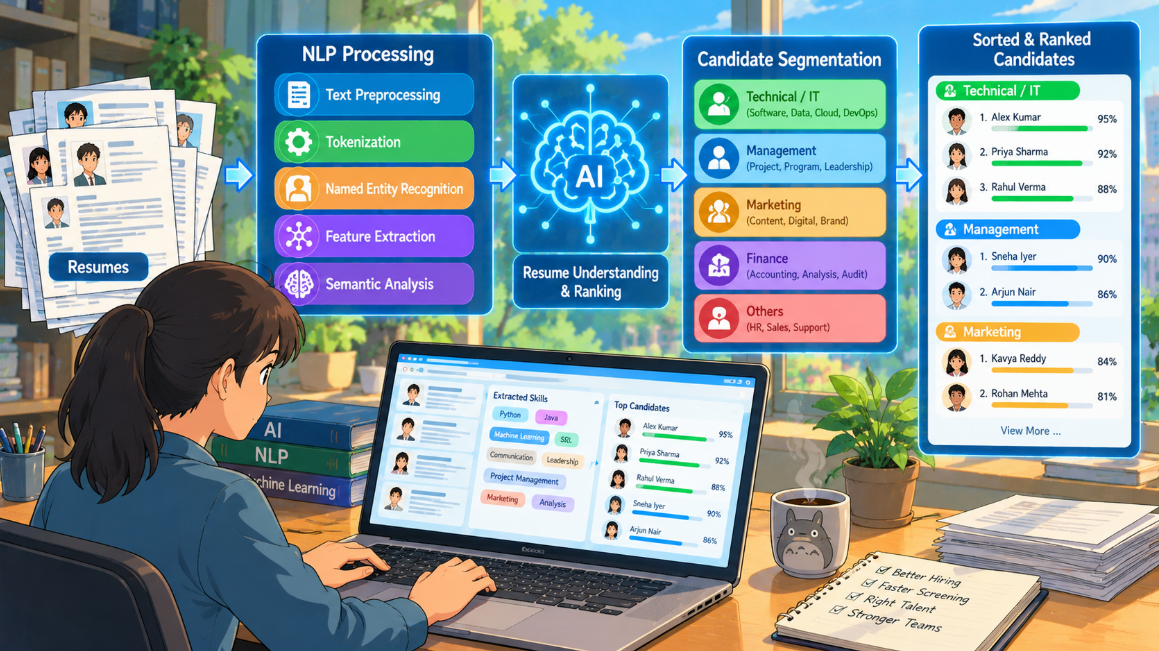
An AI-based system designed to simplify and improve the recruitment process through Artificial Intel...