
A common way to plan data collection is to train a model on a few small subsets, fit a power law to the learning curve, and extrapolate to the size at which a target error is reached. The forecast is quoted without an error bar, and the extrapolation is far outside the range of the data. We analyse this procedure. For a log-log least-squares fit, the standard deviation of the logarithm of the predicted size is (?/?)?(1/m + (log n? ? x?)²/Sxx), where ? is the relative noise of the pilot errors, ? the slope, m the number of pilots and x?, Sxx the mean and spread of their logarithms; the formula matched simulation within 1% and gave intervals with coverage between 94.0% and 95.2%. With five pilots between 20 and 160 cases and 5% noise, a forecast of 10,000 cases has a 95% interval of a factor of 1.7. Spreading the pilots more widely, or placing half at each end, shrinks the uncertainty. The log-log fit is also biased when the true curve has an irreducible error: because the curve flattens, the extrapolation is optimistic, and with an asymptote of 0.03 it predicted 38% of the true size for a target of 1,280 cases and 13% for 5,120. A three-parameter fit removes the bias but failed in 27% to 40% of the cases. The test set contributes noise of ?((1 ? e)/(eN)), which is 25% for a 3% error on 500 test cases. On the digits and breast cancer datasets the median forecast was between 43% and 112% of the true size. Synthetic results are simulations; the real data are three small learning curves.
Turn pages by dragging a corner, clicking a page, or with the ← → keys.
Loading article…
Open the PDF instead
DOI: https://doi.org/10.63328/IJRDES-V8RI6P7
OpenYou've reached the end of this article.
Uma Maheswari Krishnamoorthy , " Learning-Curve Extrapolation Under Limited Data: Bias and Uncertainty in Predicting Training-Set Requirements ", International Journal of Research and Development in Engineering Sciences (IJRDES), Volume 8 , Issue 6 , pp 68–77, November 2026. CrossRef DOI: https://doi.org/10.63328/ijrdes-v8ri6p7
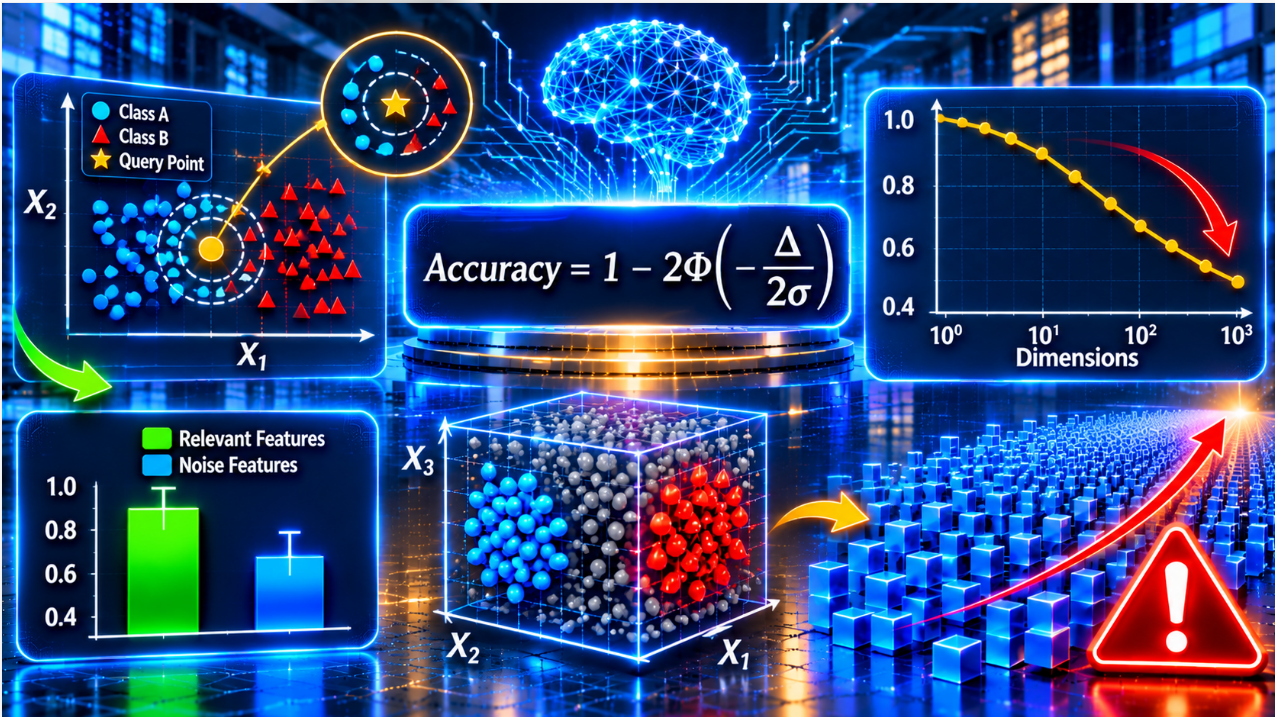
Nearest-neighbour classifiers degrade when irrelevant features are added, and the usual explanation ...

Model comparisons often report the mean accuracy over K random seeds and judge the gap against the s...
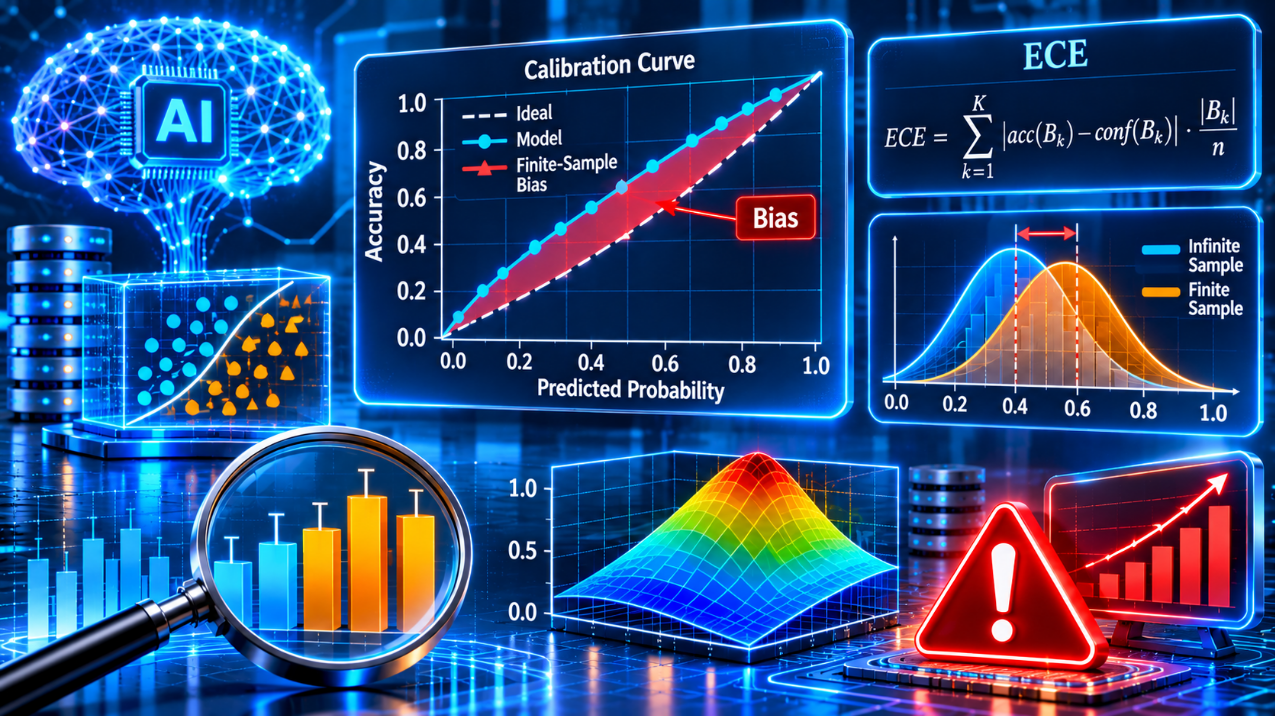
The expected calibration error (ECE) is the standard number for reporting how well a classifier’s ...

Choosing the most promising features on all the data and then cross-validating a classifier on them ...