
Nearest-neighbour classifiers degrade when irrelevant features are added, and the usual explanation is that distances concentrate in high dimensions. We make this exact for the one-nearest-neighbour rule in a Gaussian model with s signal dimensions, p noise dimensions and class separation d. Conditioning on the test point, the squared distances to training points are non-central chi-square variables, and the accuracy is a two-dimensional integral over the test point’s noise norm and signal offset (Eq. 4). The formula agreed with simulation to within 1.9 points in all 72 cells of a grid with 0 to 1,000 noise features and 20 to 5,000 training cases (mean absolute difference 0.7 points). It shows that the number of training cases needed for a fixed accuracy grows exponentially with the number of noise features, approximately as exp(p/d²): for d = 3, 80% accuracy needs 14 cases with 10 noise features, 61 with 20, 2,898 with 50 and 1.7 million with 100. With 1,000 noise features the nearest neighbour has the right class for only about 61% above chance even with 5,000 training cases. On the digits dataset, adding 1,000 noise features reduced 1-NN accuracy from 97% to 40% with 1,300 training cases, while logistic regression and a random forest fell far less. The formula, heat maps and contour plots in this paper replace the qualitative curse-of-dimensionality argument by numbers. Synthetic results are simulations; the real data are one small benchmark set with appended noise.
Turn pages by dragging a corner, clicking a page, or with the ← → keys.
Loading article…
Open the PDF instead
DOI: https://doi.org/10.63328/IJRDES-V8RI6P9
OpenYou've reached the end of this article.
Praveen Kumar Maharana , “ Nearest Neighbours and Noise Features: An Exact Accuracy Formula and the Exponential Cost of Irrelevant Dimensions ” , International Journal of Research and Development in Engineering Sciences (IJRDES), Volume 8 , Issue 6 , pp 88 – 96, November 2026. CrossRef DOI: https://doi.org/10.63328/ijrdes-v8ri6p9

Model comparisons often report the mean accuracy over K random seeds and judge the gap against the s...
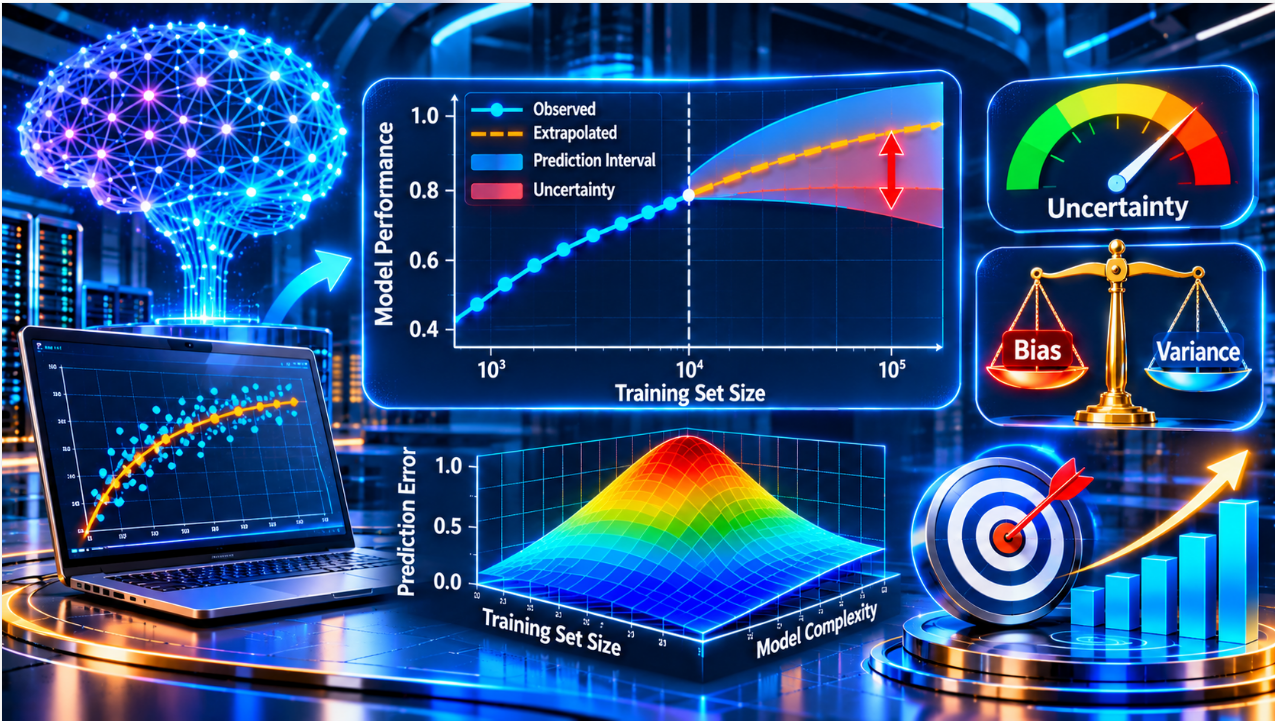
A common way to plan data collection is to train a model on a few small subsets, fit a power law to ...
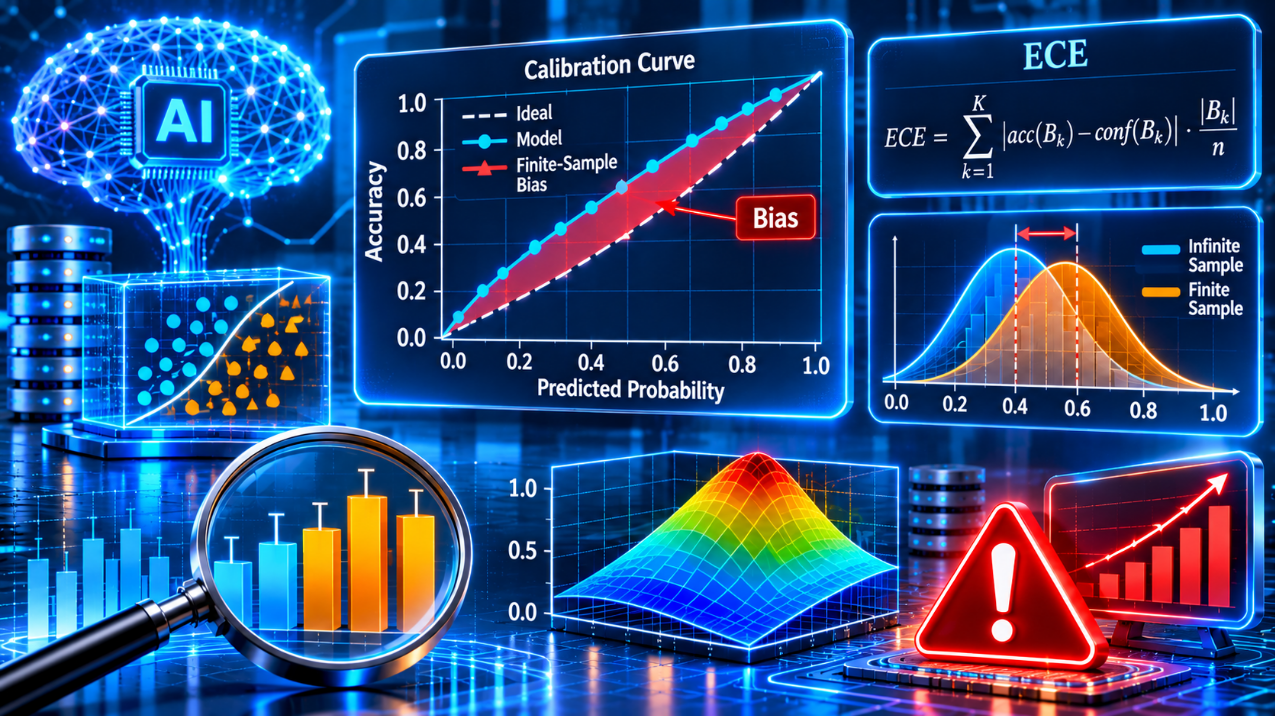
The expected calibration error (ECE) is the standard number for reporting how well a classifier’s ...

Choosing the most promising features on all the data and then cross-validating a classifier on them ...